Supercoin
Designing trust into a new payment paradigm
00
problem
problem
The challenge was to introduce a crypto-based payment solution to users who are more familiar with traditional banking, without increasing friction or uncertainty. Crypto introduces new concepts, terminology, and behaviours that can feel complex and risky — particularly for users without prior exposure. The problem was not just enabling transactions, but designing an experience that felt simple, trustworthy, and intuitive within an unfamiliar paradigm.
solution
A rand-backed stablecoin and integrated digital wallet that creates a closed-loop payments ecosystem — reducing reliance on third-party providers, lowering transaction costs, and rewarding customers for transacting within the platform. The wallet offers a virtual card, a full VAS suite including airtime, data, vouchers and transport, and a foundation for future cross-border remittance through currency pairs across Supergroup's other markets.

overview
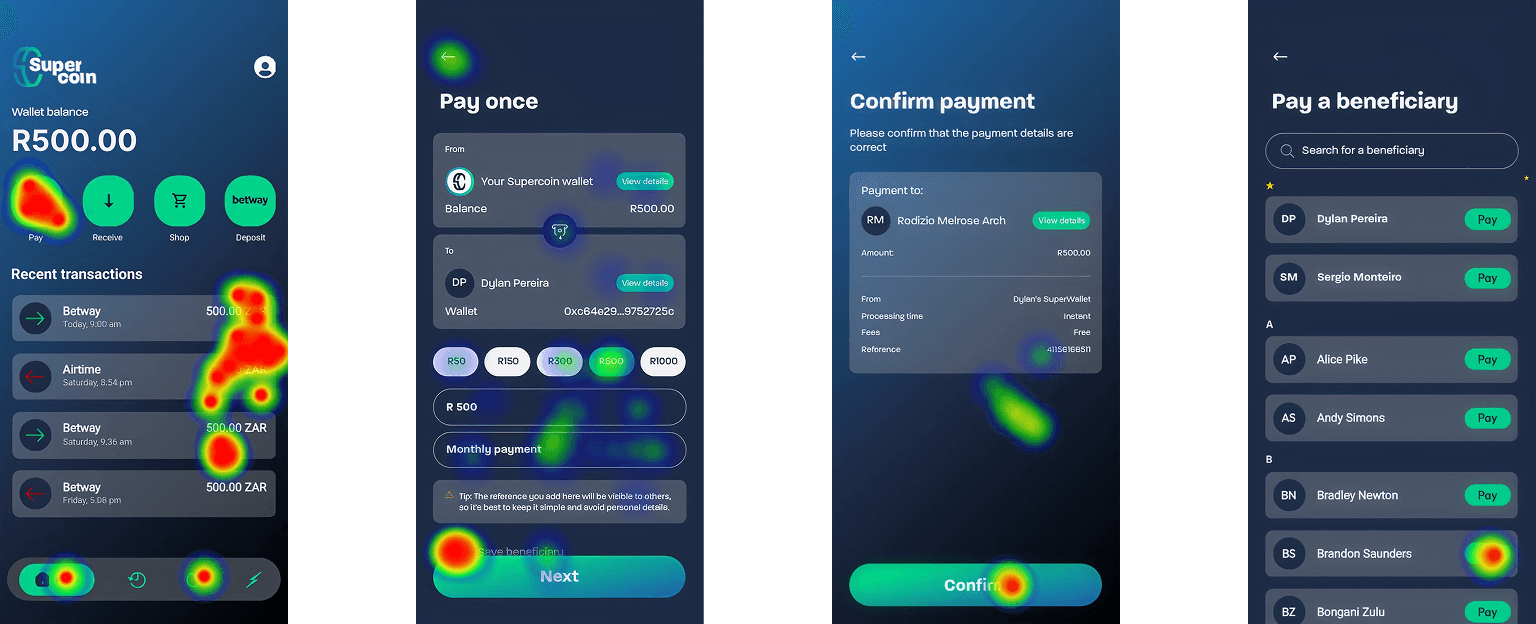
The design challenge wasn't just building a wallet - it was building trust in an entirely new payment paradigm for users who may never have held a formal bank account. I led the full product lifecycle from research through pilot: understanding what "safe" and "accessible" meant to this user base, translating complex stablecoin infrastructure into interactions that felt familiar and transparent, and designing every state - balance visibility, transaction clarity, pending flows — to reduce anxiety and build confidence. The result is a product that serves both a commercial imperative and a genuine financial inclusion need.
my role
I led the product from a front-end and UX perspective, working across:
Defining the product experience and flows
Aligning stakeholders across product, tech, and operations
Prioritising features and managing delivery
Ensuring a seamless and intuitive user journey
research
A series of interviews and mini-workshops were conducted with stakeholders across product, operations, and customer support to understand user behaviours, mental models, and pain points around payments and crypto.
My research encompassed —
• Understanding how users perceive crypto compared to traditional payment methods
• Identifying common mental models around deposits, withdrawals, and transaction flow
• Mapping key pain points in existing payment journeys
• Understanding what drives trust and confidence in financial transactions
• Analysing operational challenges and common support queries
key findings
• Crypto is perceived as high-risk and complex
Users associate crypto with uncertainty, leading to hesitation and lower adoption
• Mental models are rooted in traditional banking
Users expect clear steps, confirmations, and reversibility — similar to card or EFT payments
• Lack of feedback creates anxiety
Unclear transaction states (pending, processing, confirmed) lead to frustration and support queries
• Technical language is a major barrier
Wallet addresses, confirmations, and network details are not well understood by most users
• Trust is driven by clarity, not features
Users feel more confident when information is simple, visible, and easy to understand
year
2025
timeframe
1 Year
tools
Figma,
category
UI/UX
01
02

03

04

05